
To strengthen your personal brand credibility, make your value clear and trustworthy. First, audit what employers find when they search your name. Next, write a brand statement and align your LinkedIn profile with it. Then build a personal website that holds your best work. Finally, share your results at work and online, and build relationships with mentors and sponsors.
Key Takeaways
- Your personal brand is what people believe about you, so shape it on purpose instead of leaving it to chance.
- Employers increasingly judge proven skills, so back your claims with case studies and work samples.
- A short brand statement keeps your résumé, LinkedIn profile, and website telling one story.
- A personal website gives you one place you fully control to show projects and results.
- Inside your company, visible results and a sponsor influence who earns promotions and bigger projects.
- Small monthly actions build a brand that grows in value.
- Track profile views and project invitations, not likes, to measure whether your brand works.
Table of Contents
Why Good Work Is No Longer Enough
You do solid work and hit your deadlines. Yet a peer with a similar background lands the interview or the bigger project first. Often, visibility makes the difference, not talent.
When you clarify your personal brand, people see your value before they meet you. Many hiring managers search your name before an interview, and leaders often compare people they barely know. In both cases, your brand fills in what they cannot see firsthand, whether you shape it or not.
This guide explains what a personal brand is and why it drives career growth. It also gives you a seven-step process and a 90-day plan to put it into action. For the bigger picture, start with our complete personal branding guide.
What Does It Mean to Enhance Your Personal Brand?
Your personal brand is what people believe about you and expect from you. Harvard Business School faculty say the goal is a story that is accurate, coherent, compelling, and differentiated (HBS Online).
In plain terms:
- Accurate: What people believe about you is true.
- Coherent: Your résumé, profiles, and conversations tell the same story.
- Compelling: Your story makes people want to learn more.
- Differentiated: People see what sets you apart from peers with similar degrees.
To enhance your brand, strengthen all four without inventing a new persona. The result is still you, only easier to find and remember.
Why Your Personal Brand Matters for Professional Growth
Clarity matters more now than it did a few years ago, because hiring has shifted toward proof. Many employers use skills-based hiring, which judges what you can do instead of where you studied. In a recent national survey, nearly 70% of employers reported using it (NACE). Just 42% still screen candidates by GPA (NACE).
This shift puts the burden of proof on you. A skill listed on a résumé is easy to claim and hard to verify.
Inside your company, timing matters too. Promotions cluster early in a role, and workers promoted once are much more likely to earn another (Revelio Labs). Early wins compound, so the first years of your career carry extra weight.
A strong brand helps in both places. It gives recruiters proof of your skills and shows leaders what you can take on.
How to Enhance Your Personal Brand in 7 Steps
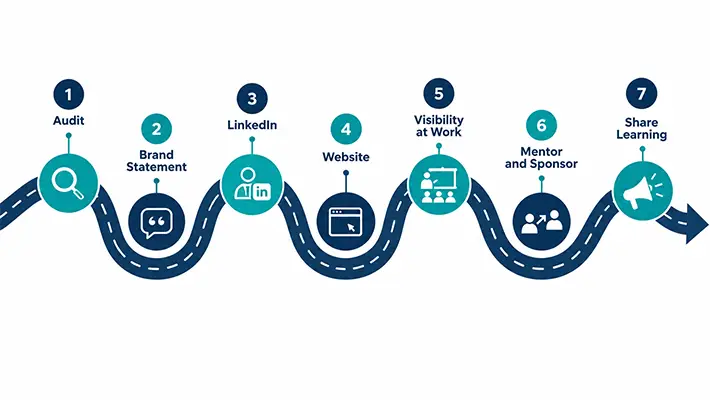
Here is how to strengthen your brand. Each step builds on the last, so work through them in order. Repeat the cycle every few months as your career grows.
- Audit what people already see.
- Define your value and write a brand statement.
- Turn your LinkedIn profile into proof.
- Build a personal website you own.
- Make your work visible inside your company.
- Find a mentor and a sponsor.
- Share what you are learning.
Step 1: Audit What People Already See
Before you build anything new, run a quick digital footprint audit. Search your full name in a private browser window, and check the first two pages of results, including images.
Then review every public profile you own. Flag old photos, outdated job titles, and posts that no longer fit who you are. Personal branding expert William Arruda recommends auditing your online presence at least quarterly (Forbes).
Sort what you find into three groups:
- Keep: Content that supports the professional you are becoming.
- Update: Profiles with old titles, missing skills, or weak photos.
- Remove or hide: Posts that could raise doubts with an employer.
Search results show only part of your brand. Ask three to five coworkers or former managers two quick questions:
- What do you rely on me for?
- How would you introduce me to a hiring manager?
Repeated answers reveal the reputation you already have.
Step 2: Define Your Value and Write a Brand Statement
Every strong brand starts with a clear message. A personal brand statement summarizes who you help, the results you create, and how you create them.
First, pick one goal for the next six to twelve months, like a promotion or a career change. That goal decides who your brand needs to reach.
Next, name your values, since they shape the work you want to be known for. Our guide to identifying your personal values walks you through it. Then list three strengths that coworkers or managers often mention.
Finally, combine your goal, values, and strengths into one clear line. Here is an example from a junior analyst:
I turn messy data into clear visuals that help nontechnical teams make faster decisions.
It works because it is specific enough to remember and short enough to repeat. Keep your labels honest, too. If you are still building a skill, say you are focused on it instead of calling yourself an expert.
Step 3: Turn Your LinkedIn Profile Into Proof
Recruiters often check LinkedIn right after your résumé. Your profile should echo your brand statement in a fuller, more personal way.
Arruda recommends an About section that is 70% likability and 30% credibility (Forbes). Let your headline and experience entries prove your skills. Use the About section mostly to show who you are and why you do this work.
When you optimize your LinkedIn profile, focus on these upgrades first:
- Headline: Name your specialty and the value you create, not just your job title.
- About section: Tell a short story about why you do this work and where you are heading.
- Featured section: Pin two or three real work samples, such as a report or presentation.
- Experience entries: Lead with results and numbers.
Step 4: Build a Personal Website You Own
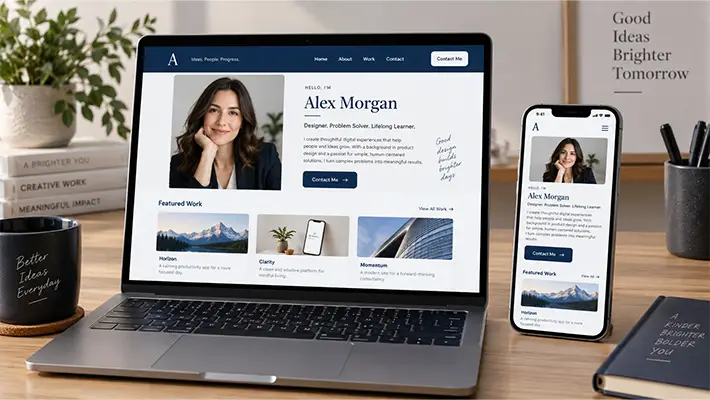
LinkedIn controls its own layout, rules, and reach. That’s why personal brand websites matter for early-career professionals. On your own site, you decide everything, from full project stories to a bio in your own words.
A website also connects the pieces of your brand. Your résumé summarizes your experience, LinkedIn helps people find you, and your website proves what you can do. Our comparison of résumés, LinkedIn, and personal websites explains how the three work together.
A strong early-career website includes:
- A short bio that matches your brand statement.
- Three to five work samples that show the challenge, your role, and the result.
- Testimonials from managers, clients, or mentors.
- Clear contact details and links to your profiles.
Want to skip the design work? See how we build websites for professionals at your career stage.
Step 5: Make Your Work Visible Inside Your Company

Your online presence is only half of your brand. Your internal brand, how managers and leaders see you, often determines who gets bigger projects and promotions. Many early-career professionals assume their work speaks for itself, but busy managers often miss key details. Visible results drive early-career advancement.
Career advisors recommend aligning your brand with company values and seeking challenges outside your usual circle (Robert Half). If your company values new ideas, for example, share one in your next team meeting. Cross-department projects also introduce you to leaders outside your team.
Try these habits:
- Send a short recap to your manager after each major project.
- Prepare one useful idea or question before important meetings.
- Volunteer for one cross-team project each year.
- Become the go-to person for one specific skill.
Back these habits with a wins file, also called a brag document. By review time, you and your manager can easily forget much of your work (Julia Evans). A written log fills that gap. For each win, record the task, why it mattered, and the result. Credit your team in public, and track your own part in private.
Step 6: Find a Mentor and a Sponsor
Visibility grows faster when experienced people guide you and speak up for you. A mentor advises you so you can open doors yourself. A sponsor, usually a senior leader, uses their influence to open doors for you. Both matter, but sponsors are far rarer.
Only 40% of employees have a mentor at work, and just 23% have a sponsor (Gallup). Employees with either one were more than twice as likely to agree that their employer offered a clear career plan strongly.
To build these relationships, follow this sequence:
- Identify leaders whose work you respect, ideally two or three levels above you.
- Help with their priorities before you ask for anything.
- Excel on any project that puts you in their view.
- Tell them your career goals directly so they know how to help.
Earn sponsorship before you ask for it. Leaders sponsor people who have already proven they are reliable and focused.
Informational interviews, short and low-pressure chats about someone’s job, help you meet possible mentors. Career coach Steve Dalton recommends covering five topics in this order:
- Trends: What changes are you seeing in your field?
- Insights: What surprised you most about your role?
- Advice: What would you focus on in my position?
- Resources: Which books, groups, or tools do you recommend?
- Assignments: What project could help me build relevant skills?
Starting with trends keeps the conversation focused on their world instead of your job search. Afterward, follow up and share how you used their advice.
Step 7: Share What You Are Learning
The last step keeps your brand active between job searches and reviews. You can start posting long before you become an expert. Sharing what you learn shows curiosity and clear thinking, two traits employers value when they hire for potential.
Publish one thoughtful LinkedIn post every week or two. Consistency matters more than volume. Good topics include:
- A lesson from a recent project, including what you would do differently.
- Your take on an industry trend or report.
- A short breakdown of how you solved a specific problem.
This approach is called learning in public. As you share lessons along the way, your notes become proof of how you think.
Use AI tools to outline and edit posts, not to invent experiences, results, or opinions. Start with a real observation, write in your own voice, and check every fact before you publish.
Specific stories beat vague posts. Good digital storytelling turns everyday experiences into posts people remember.
Turn Claims Into Proof
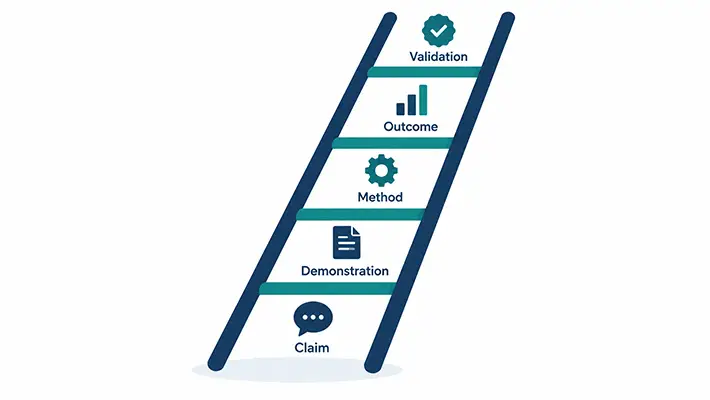
Each step above depends on evidence. To check yours, rate each key skill on the proof ladder below. Then work to move your most important skills toward the top.
| Level | What It Looks Like | Example |
| Claim | You say you have the skill | A résumé line that says you can run market research |
| Demonstration | A work sample shows the skill | A competitor analysis you created |
| Method | A repeatable process proves it | A customer interview guide or research checklist you reuse |
| Outcome | A documented result backs it up | A recommendation your team adopted |
| Validation | Someone else confirms it | A manager recommendation or an invitation to present |
Use a Simple Case Study Format
Case studies move you up the ladder because they show your thinking, not just your output. Structure each one in six parts:
- Context: Where the work happened and who it served.
- Problem: What obstacle or opportunity you faced.
- Your role: What you personally owned.
- Approach: What you did and why you chose that path.
- Result: What changed, with accurate numbers where possible.
- Lesson: What you would keep or change next time.
Self-directed projects count too, as long as you label them honestly as your own work.
Examples and Templates You Can Use
Once you have proof, you need clear words to present it, and a few templates can save you time. Adapt the examples below to your field.
Brand Statement Formula
Combine three parts: the audience you help, the result you create, and the strength you use to create it. Here is how that looks for a marketing professional:
I help growing nonprofits reach new donors through clear, data-backed email campaigns.
LinkedIn Headline Examples
- Marketing Coordinator | Content Strategy | Helping Software Companies Win New Customers
- Junior Data Analyst | Excel, SQL, Tableau | Making Complex Data Easy to Act On
- Project Coordinator | Healthcare Operations | Keeping Cross-Team Projects on Time
Experience Entry Example
Replace duty lists with what you did and what it delivered. Compare these two versions:
Weak: Assisted with social media and wrote content.
Stronger: Researched audience questions and competitor posts to plan a four-week campaign, then built a report to track results.
The stronger version shows how you worked and what you produced. Add a real result whenever you have one. Use only accurate numbers, and credit your team for shared wins.
Project Recap Email Example
Send a short note like this to your manager after a major project:
Subject: Recap of the new hire onboarding project
Hi Dana, the new onboarding guide went live last week. I rewrote six training modules and added a quick-start checklist. Early feedback shows new hires finish setup two days faster. Next, I would like to test the guide with the sales team. I am happy to walk you through the details.
A 90-Day Plan to Enhance Your Personal Brand
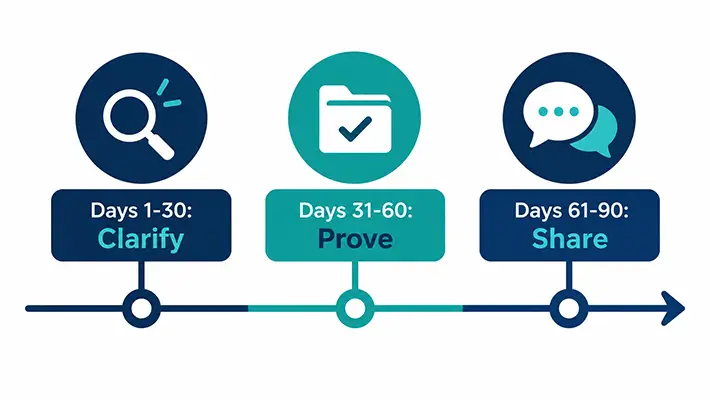
The seven steps work best on a schedule. This plan spreads them across three months, at two to three hours per week.
Days 1-30: Clarify
- Choose one career goal and two or three target roles.
- Read 10-15 job posts for those roles and note the skills that repeat.
- Ask three to five people for feedback, then write your brand statement.
- Audit your footprint, update LinkedIn, and start your wins file.
Days 31-60: Prove
- Turn one completed project into a case study.
- Launch or refresh your personal website.
- Ask two people who saw your work for LinkedIn recommendations.
- Turn three wins into short stories for job interviews or reviews.
Days 61-90: Share
- Publish one useful post every week or two, and leave thoughtful comments each week.
- Hold one networking conversation each week, such as an informational interview.
- Ask your manager for one stretch assignment, meaning a task just beyond your current role.
- Review which activities led to real conversations or opportunities.
How to Measure Your Personal Brand
As your plan unfolds, measure whether it is working. Likes and follower counts are easy to track but reveal little about career progress. Track signals that point toward real opportunities instead.
| Signal Type | What to Track |
| Discovery signals | Profile views from recruiters or your target industry, portfolio visits, and how often you appear in LinkedIn searches |
| Credibility signals | New recommendations, invitations to present, and thoughtful replies to your posts |
| Opportunity signals | Interviews, referrals, stretch assignments, and project invitations |
| Career outcomes | Promotions, new roles, broader responsibilities, and higher pay |
Discovery signals can appear within weeks. Career outcomes can take a year or more, so review your scorecard monthly and stay patient.
Common Mistakes That Weaken Your Personal Brand
Six common habits weaken even a well-planned brand. Watch for them.
Being Vague About Your Value
Calling yourself a hard worker and a team player makes you forgettable, because those phrases describe almost everyone. Instead, pick one or two specific strengths you want to be known for. Repeat them in your résumé, LinkedIn headline, website, and introductions. Specific claims backed by examples are easier to remember and trust. Vague claims blend into every other application.
Letting Your Profiles Drift Apart
Your résumé lists one title, LinkedIn shows another, and your website still describes your internship. Mixed signals make employers wonder which version is true. Keep your core story the same on every platform, down to your name and photo. Your tone can shift by platform, but your facts and focus should match. Set a calendar reminder to review every profile once a quarter.
Waiting Until You Feel Like an Expert
Many early-career professionals stay quiet online because they feel too new to have opinions. That delay can cost you months or years of visibility. Readers often connect most with people who are still learning, because their lessons feel fresh and honest. Share what you tried and what surprised you along the way. Honest learning posts build credibility faster than polished posts you never publish.
Claiming Expertise You Cannot Prove
Calling yourself an expert or thought leader early in your career can backfire. Hiring managers test those claims in interviews, and gaps quickly damage trust. Choose labels that match your evidence. Phrases like focused on or building experience in sound honest and confident. Specific proof, such as three completed research projects, persuades far more than an inflated title.
Doing Invisible Work Without Credit
Updating documentation, onboarding new hires, and organizing meetings keep a team running. Engineer Tanya Reilly calls these tasks glue work. Teams depend on it, yet promotion decisions often overlook it. Do your fair share, and balance it by owning visible core projects. Log the impact of your glue work in your wins file, such as hours saved or errors prevented.
Treating Your Brand as a One-Time Project
A profile you last updated two years ago tells people you stopped growing. Grow your brand as your skills and goals change. Build a simple routine so a job search never forces a rushed update. Add new wins monthly, refresh your website quarterly, and revisit your brand statement yearly.
Tools and Resources
A few low-cost tools make it easier to avoid those mistakes, and real examples show what a finished brand looks like. For inspiration, browse our sample personal brand websites to see how other professionals present their work. For a polished site without the build time, let our team create it for you.
Here is how each tool strengthens your brand.
Google Alerts
Google Alerts emails you when your name appears in new search results. Set an alert for your full name in quotation marks to catch exact matches. You learn about new mentions as they happen, not months later. That gives you time to share good news, such as a feature on your company blog. It also lets you correct inaccuracies before a recruiter finds them.
LinkedIn Analytics
LinkedIn shows how your posts and profile perform. You can track impressions, reactions, and comments on each post, plus how many people viewed your profile. These numbers reveal which topics connect with readers. If posts about project lessons beat industry news, write more project lessons. Profile view trends show whether your headline and About updates attract the right people.
Canva
Canva offers free templates sized for LinkedIn banners, post graphics, and résumés. Its drag-and-drop editor works without any design training. A clean banner that reflects your field makes your profile look finished and intentional. Simple visuals, such as a chart from a project, help your posts catch attention in a busy feed. Reuse the same colors and fonts so your brand looks consistent everywhere.
A Wins File
A wins file is a simple document or spreadsheet where you log accomplishments each week. Record the task, why it mattered, the result, and any praise you received. This habit turns scattered memories into ready-made proof. You will draw on it for performance reviews, résumé updates, LinkedIn posts, and interview answers. It also strengthens promotion and salary conversations, because you can point to specific results.
People Also Ask
Here are quick answers to questions readers often ask when they start building their brand.
How long does it take to enhance your personal brand?
You can see progress within weeks, because an audit and a LinkedIn refresh take only a few sessions. Recognition takes longer, often several months of steady posting and relationship building. A brand works like a savings account. Small, regular deposits grow over time, while one big burst followed by silence fades quickly.
Can you build a personal brand without posting on social media?
Yes, though posting speeds things up. Your brand also lives in your everyday work and in how you treat people. Clear project recaps count, and so does a polished LinkedIn profile or a website with real results. Speaking up in meetings and helping coworkers shape how people see you also matters. Posting reaches more people, so try it once you feel ready.
What is the difference between a personal brand and a reputation?
The two overlap, but the difference is intent. Your reputation forms on its own from everything people notice about you. Your personal brand is what you shape intentionally through the proof you share and the story you repeat. A strong brand gradually pulls your reputation toward your goals. Without one, other people’s assumptions fill in the story for you.
Does a personal brand help with promotions?
It often does. Promotions depend on decision-makers knowing what you have done and believing you can handle more. A clear internal brand answers both questions. Regular project recaps help, and a sponsor who speaks up for you helps even more. A brand complements strong work by making sure the right people notice it.
Is a personal website worth it if you already have LinkedIn?
For most early-career professionals, yes. LinkedIn controls how much you can show and how it looks. A website gives you room for full project stories, and you control every detail. It also gives recruiters one link that holds your complete story. LinkedIn helps people find you, and your website helps them understand why they should contact you.
Your Personal Brand Checklist
Use this checklist to track your progress through the seven steps and the 90-day plan.
| Status | Action |
| ☐ | Choose one career goal for the next six to twelve months. |
| ☐ | Search your name and review the first two pages of results |
| ☐ | Ask three to five people how they would describe your strengths |
| ☐ | Update or remove outdated profiles and posts |
| ☐ | Write a one- or two-sentence brand statement |
| ☐ | Refresh your LinkedIn headline, About section, and Featured section |
| ☐ | Turn one project into a case study |
| ☐ | Launch a personal website with three to five work samples |
| ☐ | Start a wins file and update it weekly |
| ☐ | Send a recap to your manager after your next major project |
| ☐ | Identify one potential mentor and one potential sponsor |
| ☐ | Publish one learning post every week or two |
| ☐ | Review your brand scorecard each month |
Enhance Personal Brand Value That Grows With You
Your brand already shapes how people see you, so why leave it to chance? When you clarify your personal brand, people see your value before the first conversation.
Start with the first 30 days of the plan above. Audit your footprint, write your brand statement, and update your LinkedIn profile. Then build the website that ties your story together, and keep adding proof as you grow.
A professional website gives you a home base that works for you around the clock. Build your personal brand website with Bright Future Branding today and give employers a clear reason to choose you.
Additional Resources
Frequently Asked Questions
What is the fastest way to enhance my personal brand?
Start with your LinkedIn profile, since recruiters often check it first. Rewrite your headline around your specialty and value, then add two or three work samples to the Featured section. Add a link to your personal website there too. Next, write a short brand statement and use it across your résumé and profiles. These changes take only a few hours, yet they make your value clearer to anyone who looks you up.
How often should I update my personal brand?
Review your profiles and website at least once each quarter. Add new projects and results as they happen instead of saving them for a job search. Revisit your brand statement once a year or whenever your goals change. Regular small updates keep your brand accurate and show employers that you are still growing in your field. Updating your wins file each week makes these refreshes fast and easy.
Do employers really look at candidates online?
Many do, and the shift toward skills-based hiring makes online proof even more valuable. A quick search of your name may surface your LinkedIn profile, your website, or old social posts. While you cannot control every result, you can make the strongest ones reflect your current goals. Fix anything outdated before your next application. Search your own name in a private browser window to see what an employer finds first.
What should I post on LinkedIn if I am new to my field?
Post about what you are learning on the job. Share a lesson from a project, a takeaway from a course, or your view on a recent industry report. Be specific about what you did and what happened as a result. Honest learning posts feel relatable and show curiosity, which many employers value in early-career hires. Aim for one post every week or two so people start linking your name to your field.
How is a mentor different from a sponsor?
A mentor shares advice and guidance so you can make better decisions on your own. A sponsor is a senior leader who actively advocates for you in rooms you are not in. Sponsors recommend you for projects and promotions. Most people benefit from both, but sponsors are rarer, so building that relationship early gives you an advantage. Start with a mentor, then earn a sponsor by doing excellent work that leaders can see.
Should my personal brand be different on each platform?
Keep your core message, name, photo, and main focus the same on every platform. Your tone can shift slightly, such as more formal on LinkedIn and more personal on your website. However, facts like job titles and dates should always match so people trust what they see. Run a quick side-by-side check of every profile each quarter to catch mismatches early. Consistency signals reliability before anyone talks to you.
What should I include on a personal brand website?
Include a short bio, three to five work samples, and clear contact details. For each sample, explain the challenge, your role, and the result. Testimonials from managers or clients add credibility. Link to your LinkedIn profile and keep the design clean. Aim to show your value within a minute or two. A focused one-page site with strong proof often beats a sprawling one. Update it whenever you finish a project worth showing.
Can a personal brand help me change careers?
Yes. A strong brand helps you reframe experience for a new field. Identify the skills that transfer, then share content and complete projects related to your target role. Informational interviews with people in that field build connections and insight. Share why you are changing direction, since an honest story builds more trust than hiding the past. Over time, your public story catches up, and the change looks planned rather than random.
How do I build my brand if I feel uncomfortable promoting myself?
Treat it as documenting your work, not bragging. Frame your results around team impact and what you learned. Researcher Herminia Ibarra suggests treating new behaviors as small experiments, not a change in who you are. Try one new habit, such as a project recap, and notice how people respond. With practice, those habits start to feel natural. Remember that clear updates also help your manager, who needs that information anyway.
How do I know if my personal brand is working?
Early signals appear well before career outcomes. Look for profile views from the right people and requests for your input. Promotions and new roles follow later. If months pass without new conversations, revisit your brand statement and proof. Your message may be too broad, or your best work may be hard to find. Small fixes to your headline or website often make a big difference. Then track the same signals for another month.
Glossary
| Term | Definition |
| Personal brand | The set of beliefs and expectations people hold about your skills, values, and potential. |
| Brand statement | A one- or two-sentence summary of who you help, the result you create, and how you create it. |
| Digital footprint | Everything about you that appears online, including profiles, posts, photos, and search results. |
| Internal brand | How managers, coworkers, and leaders inside your company see your work and potential. |
| Skills-based hiring | A hiring approach that judges candidates on demonstrated skills rather than degrees or GPA. |
| Mentor | An experienced person who offers advice and guidance to help you grow. |
| Sponsor | A senior leader who uses their influence to recommend you for opportunities. |
| Featured section | A LinkedIn profile area where you can pin posts, links, and work samples. |
| Owned media | A channel you fully control, such as your personal website. |
| Wins file | A running log of your accomplishments, sometimes called a brag document, used in reviews and interviews. |
| Glue work | Behind-the-scenes tasks that keep a team running but often go unnoticed in promotion decisions. |
| Case study | A short story about one project that covers the problem, your role, your approach, and the result. |